


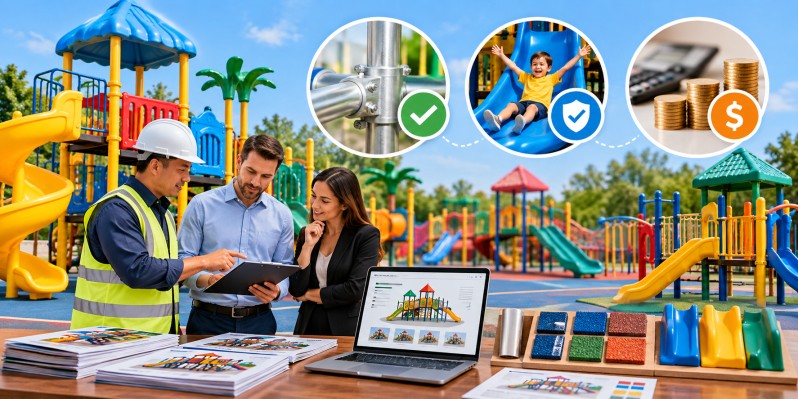
Choosing playground equipment is a significant investment for schools, parks, recreation centers, childcare facilities, and community spaces. The right supplier can make that investment worthwhile by providing durable products, strong safety features, dependable support, and fair pricing. However, comparing suppliers based only on the initial quote can lead to costly compromises later.
Evaluate Product Quality and Durability
A playground may look impressive when it is newly installed, but its real quality becomes apparent after years of exposure to children, weather, and regular use. When comparing playground equipment suppliers, look beyond appearance and ask what materials, manufacturing processes, and quality-control measures are used.
Materials should be appropriate for the intended environment and expected level of use. Metal components, for example, should have suitable protection against corrosion, while plastic components should be designed to withstand regular outdoor exposure. Structural connections and hardware also deserve attention because these components contribute to the stability and longevity of the equipment.
Ask suppliers about the expected service life of their products and whether replacement components are available. A supplier that can provide individual replacement parts may be more useful in the long run than one that requires an entire unit to be replaced when a single component wears out.
It is also worth examining the supplier’s previous projects. Photos, project references, case studies, and customer feedback can provide useful insight into how products perform after installation rather than simply how they look in a catalogue.
Consider Safety Standards and Design
Safety should be one of the first factors considered, not something evaluated after comparing prices. Playground equipment should be appropriately designed, manufactured, installed, and maintained to reduce foreseeable risks associated with normal use.
When reviewing playground equipment suppliers, ask which applicable safety standards and guidelines their products are designed to meet. Request documentation where appropriate rather than relying solely on general statements about safety compliance.
Pay attention to design details such as fall heights, protective surfacing requirements, openings, guardrails, handrails, barriers, moving components, pinch points, and accessibility. Equipment should also be appropriate for the intended age group.
Accessibility deserves particular consideration when developing a public playground. A well-planned play space should provide opportunities for children with different abilities to participate rather than treating accessibility as an optional feature.
Installation is another important part of safety. Even high-quality equipment can create problems if it is incorrectly assembled or installed. Ask whether the supplier provides professional installation, installation instructions, inspections, and ongoing maintenance guidance.
Compare Pricing and Overall Value
Price is naturally important, but the cheapest quotation is not necessarily the most economical choice. Comparing the total value of each proposal can provide a much clearer picture of what you are actually getting for your investment.
Request detailed quotations that separate equipment, shipping, installation, site preparation, surfacing, warranties, and other potential costs. This helps prevent an apparently inexpensive proposal from becoming considerably more expensive once additional requirements are included.
Look Beyond the Initial Purchase Price
A durable playground can provide value for many years, while poorly constructed equipment may require frequent repairs or premature replacement. Consider the expected maintenance requirements and availability of replacement parts when comparing suppliers.
Warranty terms can also make a meaningful difference. Check what the warranty covers, how long it lasts, and whether labour or replacement components are included. Ask what happens if a component becomes unavailable several years after installation.
The reputation and support offered by playground equipment suppliers should also factor into your decision. A supplier that remains available after installation can be valuable when equipment requires inspection, maintenance, modifications, or replacement parts.
Ask the Right Questions Before Choosing
Before signing an agreement, create a comparison checklist that covers the areas most relevant to your project. Useful questions include:
- What materials are used in the equipment?
- Which safety standards or guidelines does the equipment address?
- Is professional installation available?
- What maintenance is recommended?
- What does the warranty cover?
- Are replacement parts readily available?
- Can the supplier provide references from comparable projects?
- What additional costs should be expected?
- Can the equipment be customized for the available space?
- How does the supplier support customers after installation?
It can also be helpful to compare at least three proposals using the same criteria. A simple scoring system for quality, safety, customization, installation, warranty, service, and price can make differences between suppliers easier to identify.
For aquatic recreation facilities and splash play environments, the comparison process may require additional considerations around water systems, drainage, materials, slip resistance, accessibility, and maintenance. Choosing a supplier with experience relevant to the specific type of recreational environment can therefore be particularly valuable.
Ultimately, the best supplier is one that combines reliable products, thoughtful design, strong safety practices, transparent pricing, and responsive customer service. Taking time to evaluate these factors can help organizations create a play environment that remains enjoyable and functional for years.
FAQs
- How should I compare playground equipment suppliers?
Compare their products based on quality, safety, materials, certifications or applicable standards, installation, warranties, maintenance requirements, customer support, and total project cost rather than focusing solely on the initial price. - Is the cheapest playground equipment always the best choice?
Not necessarily. Lower-priced equipment may have higher maintenance or replacement costs over time, so consider durability, warranty coverage, installation, replacement parts, and expected service life when assessing overall value. - What safety information should a supplier provide?
Ask for information about applicable safety standards, recommended age groups, installation requirements, fall zones, protective surfacing, accessibility, maintenance, and inspection procedures relevant to the equipment being considered. - Why is a supplier’s warranty important?
A warranty can provide additional protection against certain manufacturing or material defects. Review its duration, coverage, exclusions, claim process, and whether replacement parts or labor are included. - Should I check a supplier’s previous projects?
Yes. Reviewing completed projects and customer references can provide practical insight into product quality, installation, customer service, and how well the equipment performs after it has been in use.
Ready to develop a safe, durable, and engaging recreational environment? Oasis Waterplaygrounds can help you explore quality solutions designed around your project’s needs. Contact the team to discuss your upcoming playground or waterplay project.